Graduate Research in Action
Cal Poly Electrical Engineering graduate students work alongside faculty to address consequential engineering challenges through analysis, experimentation, design, and implementation. The representative projects below illustrate the breadth of research across our five graduate focus areas and the program's commitment to Learn by Doing.
Research with real-world relevance
At Cal Poly, graduate research moves from theory to tested solutions. MSEE students work closely with faculty (and sometimes industry partners) using 35,000 square feet of specialized laboratory space to model, build, measure, and refine technologies across communications, intelligent systems, electronics, RF and photonics, and electric power. This hands-on research develops practical engineering judgment while addressing challenges in areas such as autonomous systems, sensing, connectivity, computing hardware, renewable energy, and the modern grid.
Representative Projects
Area: Control Systems and Computational Intelligence
Faculty Lead: Dr. Siavash Farzan
Project Description: Can a team of robots hold formation and avoid obstacles without ever talking to each other? In GPS-denied or radio-silent environments, coordination schemes that rely on shared state simply fail. Our research removes that dependency: each robot uses only the range and bearing it senses onboard, from which a single unified observer reconstructs the position and the unmeasured velocity of every tracked object, e.g., the robot ahead in formation or a moving obstacle crossing the team's path. We prove this estimator converges globally and exponentially, then feed its explicit error bounds directly into a control barrier function safety layer that provably guarantees inter-robot separation, obstacle clearance, and formation tracking despite the residual estimation error. Every control law is closed-form algebra rather than an online optimization, so it executes in microseconds on low-cost embedded hardware. On our multi-robot testbed, the formation maintained every safety certificate while passing obstacles and recovered its geometry with sub-centimeter error.
Area: RF Electronics, Physical Layer Communications, Antennas, Electromagnetics, THz, and Photonics
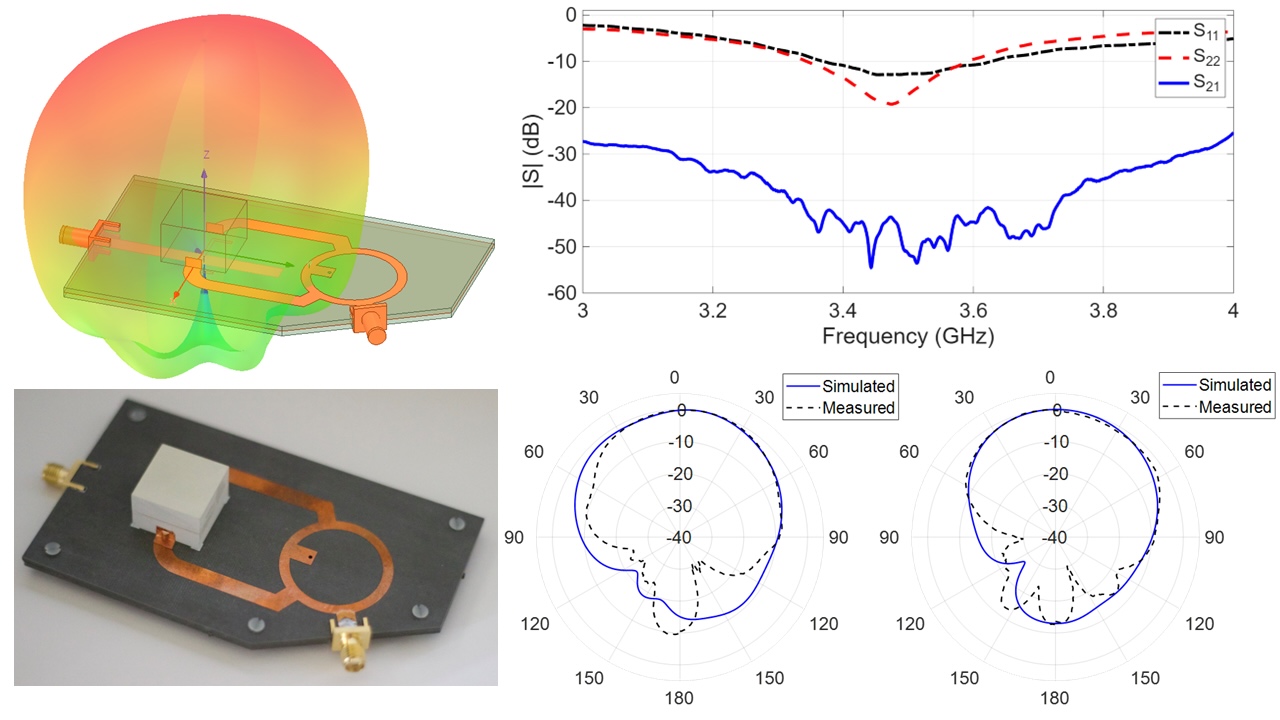
Project Title: In-Band Full-Duplex Antennas Based on Polarization Diversity
Faculty Lead: Dr. Payam Nayeri
Project Description: Yes, we can double the spectral efficiency! The frequency spectrum is limited in its quantity and effective utilization of this scarce resource is of paramount importance. Transceivers typically only operate in half-duplex (frequency division or time division duplex), which is an ineffective use of the spectrum. To maximize spectral efficiency, a transceiver must be able to transmit and receive within the same frequency band, at the same time, i.e. operate in-band full-duplex (IBFD). Self-interference, however, has shown to be a major challenge. Our research addresses these challenges and demonstrates a dielectric resonator antenna (DRA) capable of meeting the isolation requirement for IBFD operation (below 40 dB) with good radiation characteristics and impedance matching based on polarization division duplex. A 200 MHz IBFD bandwidth at the sub-6 GHz band centered at 3.5 GHz is demonstrated using a dual-feed mechanism. The feeds excite two orthogonal TEδ11 modes in the DRA which creates boresight beams with orthogonal polarizations, enabling simultaneous transmit and receive, thus operating as an IBFD antenna. We’ve also demonstrated that his antenna shows promise as elements for IBFD antenna arrays.